Hotel PMS: the operational heart of your property

Reservations, guests, rooms and daily operations in a single cloud environment. Hotellerie connects information and workflows across your property, helping your staff work in a simpler, more organized and informed way.

What is a Hotel PMS?

PMS stands for Property Management System: it is the system that brings together and coordinates the main operational activities of a hospitality property.

With Hotellerie, the PMS becomes the central point where reservations, guests, units, rooms and property operations share the same information, rather than managing each process separately.

From the moment a reservation is created until the guest leaves, information supports the staff’s daily work and can be used across the different functions of the management system.

One operational foundation, many connected activities.
From check-in to check-out: one connected workflow

Managing a stay means coordinating different moments and activities. Hotellerie’s PMS brings them together into one connected operational workflow, supporting staff throughout every stage of the guest’s stay.

Arrival, stay and departure are not separate operations, but different stages of the same process. Information stored in the PMS remains available throughout the stay and can be accessed whenever needed, without having to reconstruct what the system already knows.

This helps maintain continuity even when shifts, staff members or operational tasks change.

The PMS follows the guest journey alongside your staff.

Reservations and availability at a glance

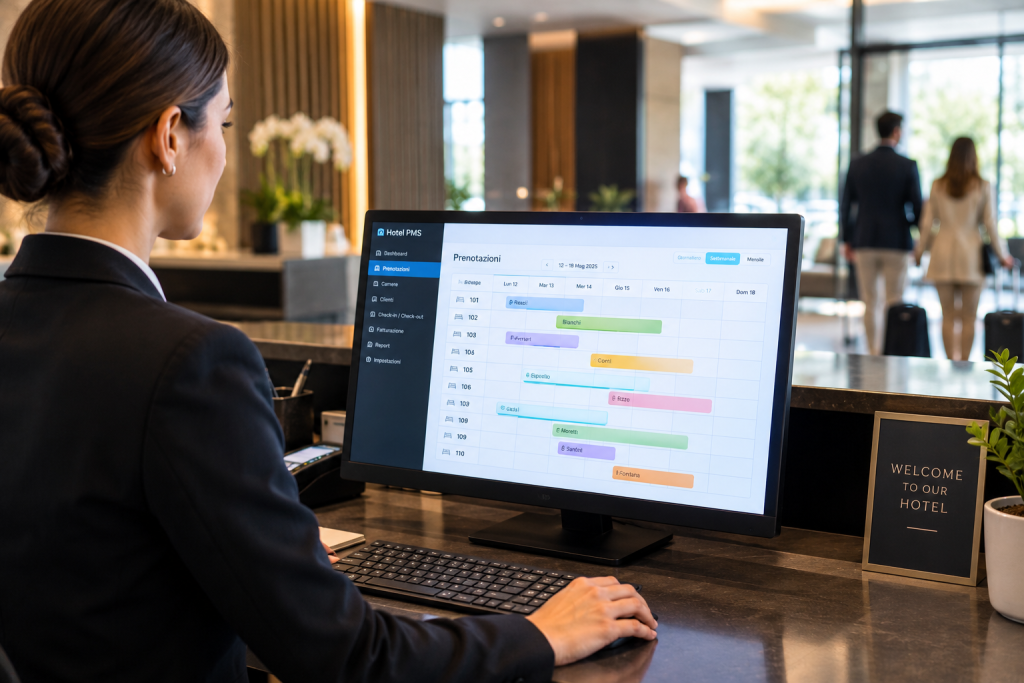
The planning view is one of the key tools in the daily work of the front desk. With Hotellerie, staff can view property occupancy and immediately see reservations, arrivals and departures, together with the availability of units and rooms.

Staff can quickly check room status and organize the work for the day or the days ahead without having to piece information together from different screens or tools.

A clear planning view makes it easier to understand what is happening across the property and what is expected over the next few hours or days.

Online check-in can further simplify arrival management by allowing guests to provide the necessary information before they arrive, reducing the number of tasks that need to be completed at the front desk.

ALT: Planning prenotazioni e disponibilità nel PMS Hotel

Reservations, guests, units, services and daily activities can share the same information and become part of one connected workflow.

Discover Hotellerie

Guest profiles: know who is staying at your property

Every stay starts with a person, not just a reservation. The PMS makes it possible to associate useful information with each guest and preserve their history over time.

Guest profiles bring together personal and contact details, administrative information and stay history, allowing staff to quickly retrieve the information they need when a guest returns to the property.

Over time, this history helps staff understand their guests better, recognize returning visitors and provide a more attentive and personalized welcome.

Units and rooms: organize your property's operations

Every unit has its own characteristics, availability and operational status, which can change throughout the day. Hotellerie helps organize units and rooms within the property and keep their current status under control.

Knowing that a room is available does not necessarily mean that it is ready to welcome a new guest. This is why unit management can be connected to the property’s operational activities, distinguishing between availability and room status.

Gestione housekeeping di unità e camere nel PMS Hotel

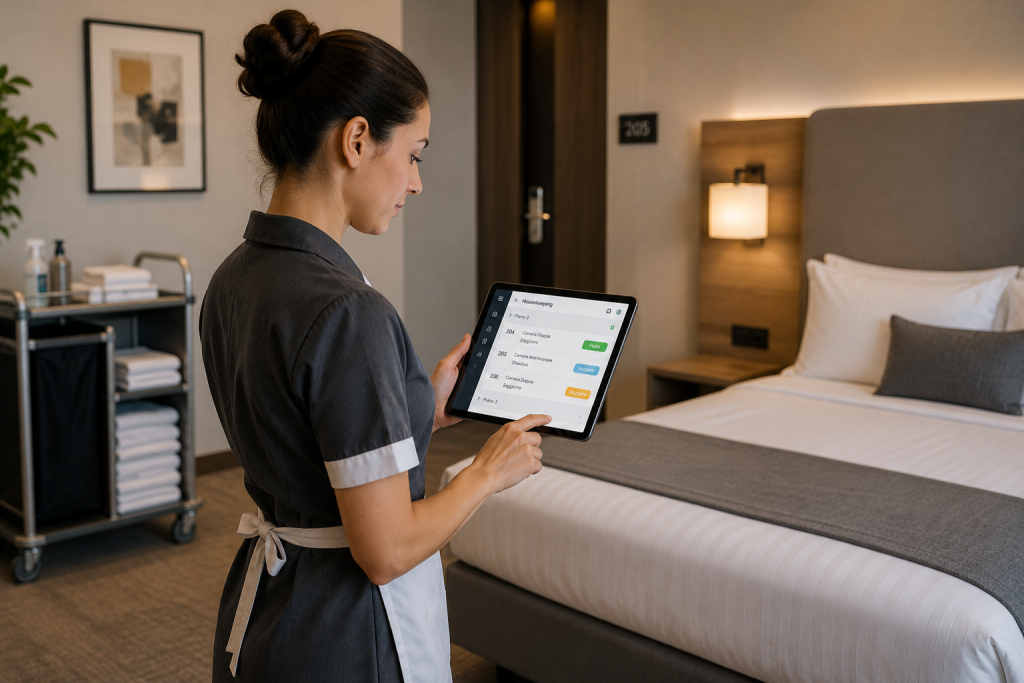
Housekeeping: rooms ready when they are needed

Housekeeping is part of a property’s daily operations and needs to be coordinated with arrivals, departures and unit status.

With Hotellerie, housekeeping activities can be organized and assigned to staff, keeping the front desk and housekeeping team aligned on the status of every unit or room.

Staff can see which units need to be prepared, which are currently being serviced and which are ready to welcome guests, prioritizing tasks according to expected arrivals.

This turns the check-out → cleaning → room ready → new arrival sequence into a visible and coordinated process within the PMS.

Services and extras: everything that completes the stay

A guest’s stay is about more than just the room. During their stay, guests may use additional services and extras offered by the property. These need to be associated with the stay and managed together with the other reservation information.

Hotellerie makes it possible to organize the services available at the property and record their use by guests, maintaining a clear view of everything that needs to be considered when preparing the final bill.

From breakfast to an additional service, the principle is simple: whatever the guest uses during their stay follows the stay through to check-out.

Check-out: the natural conclusion of the stay

At departure, room nights, services and extras are already associated with the stay and can flow into the guest’s final bill.

Check-out completes the journey that began with the reservation, while the PMS retains the history of the stay and its associated operations. Administrative requirements and related fiscal documentation can then be managed from the same information base.

A PMS designed for integrations

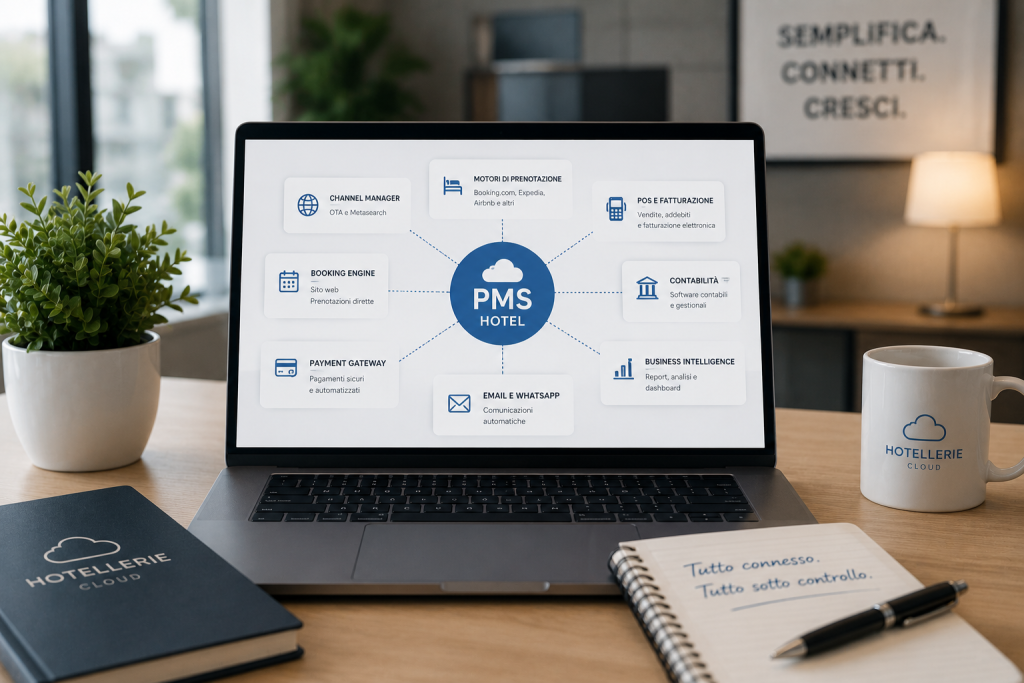
A PMS does not necessarily work alone. A property may use different systems and services that need to communicate without turning every integration into a manual process.

Hotellerie is designed to communicate with external services through APIs and integrations, allowing the PMS to become the connection point between the property’s different technologies.

Channel Managers, Booking Engines, communication systems and, where open APIs are available, even hotel automation systems can progressively become part of the same ecosystem.

The goal is not to replace every technology already used by the property, but to connect it with the management system whenever this creates a real operational benefit.

PMS Hotel integrato con i sistemi digitali della struttura

Artificial Intelligence: value starts with information

Artificial Intelligence can bring real value to a PMS when it is not treated as a separate feature, but can work with the information collected by the management system during the property’s daily operations.

Hotellerie is designed to build an operational history of the property over time: stays, reservations, services, activities and other meaningful events can become useful information for understanding what happens across the property and supporting the work of its staff.

AI can help search for information, identify relationships, summarize data and make it easier to explore the property’s information, without replacing people in decision-making.

AI does not create value simply because it is present in the management system. It creates value when it has useful information to work with.

Cloud Hotel PMS

Hotellerie is a Cloud Hotel PMS, accessible through a browser without installing management software on the property’s computers. Information and operational tools remain available wherever access to the PMS is needed.

Contact us and we’ll be happy to answer your questions!

Discover Hotellerie

Frequently Asked Questions about Hotel PMS

A PMS (Property Management System) is the system used to manage and coordinate the main operational activities of a hospitality property. Reservations, guests, units and rooms, stays and staff activities can all be managed within the same environment, keeping information organized and available throughout daily operations.

The terms PMS and hotel management software are often used interchangeably. PMS stands for Property Management System and more specifically refers to the system that supports the operational management of the property and the guest stay.

Hotel management software can include a broader range of functions, such as administration, invoicing, communications, integrations and data analysis. In Hotellerie, the PMS therefore represents the operational heart of a broader hotel management system.

The PMS manages what happens within the property: reservations, guests, stays, units and rooms, and operational activities. A Channel Manager connects the property to different online distribution channels, synchronizing information such as availability and reservations.

The two systems therefore perform different functions, but become more valuable when they can communicate with each other: information from external channels enters the PMS operational workflow without creating separate processes for staff.

Yes. A PMS is not necessarily tied to the organizational model of a traditional hotel. B&Bs, residences, apartments, resorts, campsites and other types of accommodation share many operational needs, even though their characteristics and management models may differ.

Hotellerie is designed to adapt to these differences. This is why we talk first about units, and then about rooms. The goal is not to force different types of properties to work in exactly the same way, but to provide a common management foundation that can adapt to the way each property operates.

A Cloud Hotel PMS is a management system that can be accessed via the Internet without installing software on each computer at the property.

Hotellerie can be used through a browser on PC and Mac, as well as on mobile devices such as smartphones, iPhone, iPad and tablets. Authorized staff can access PMS tools and information from the front desk, the office or while on the move, using whichever device is most appropriate at the time.

There is no need for a dedicated computer: all that is required is a device with a modern browser and an Internet connection.

Yes. A PMS can communicate with other software and systems used by the property whenever they provide APIs or other integration tools.

Channel Managers, Booking Engines, communication systems, access control systems and other services can exchange information with the PMS, avoiding separate information silos within the organization.

Hotellerie is built around this philosophy: not necessarily replacing tools that already work well within the property, but enabling them to communicate whenever integration provides a tangible benefit.

When the installed systems allow it, this principle can also extend to hotel automation, progressively connecting the management environment with the physical infrastructure of the property.